
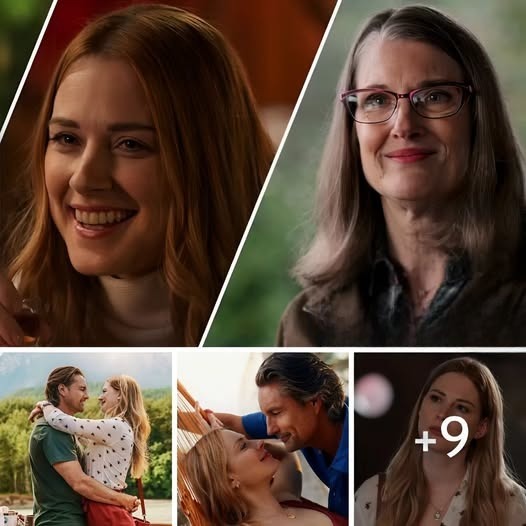
BREAKING NEWS!!! Virgin River’s Most Popular Character May Be Getting Too Much Screen Time😱😱
Few television characters have become as synonymous with their series as Mel Monroe has with Virgin River. From the moment nurse practitioner Mel arrived
in the small Northern California town seeking a fresh start after unimaginable heartbreak, viewers were captivated. Her emotional journey, resilience,
and slow-burn romance with Jack Sheridan quickly became the foundation upon which Netflix built one of its most successful romantic dramas.
For years, fans have followed Mel through grief, healing, love, family revelations, career challenges, and life-changing decisions. She has remained the beating heart of the series, with actress Alexandra Breckenridge delivering performances that consistently anchor the show’s emotional core.

But now, as Virgin River continues to expand its cast and storytelling ambitions, an unexpected debate is emerging among viewers.
Has the show’s biggest star become too central to the story?
It’s a question that has sparked passionate discussions across social media, fan forums, and entertainment communities. While few viewers dispute Mel’s importance to the series, some are beginning to wonder whether the writers have become overly reliant on the character, potentially at the expense of the show’s growing ensemble cast.
The concern isn’t that audiences dislike Mel.
In fact, quite the opposite.
Many fans continue to adore the character and praise Breckenridge as one of the strongest performers in the entire series.
The issue, according to some viewers, is balance.
When Virgin River first premiered, Mel’s story naturally dominated the narrative. She was the audience’s entry point into the town. Through her eyes, viewers met Jack, Doc, Hope, Preacher, Paige, and the many colorful residents who would eventually become fan favorites.
At the time, the focus made perfect sense.

The series was built around Mel’s attempt to rebuild her life after tragedy, and her romance with Jack quickly became one of Netflix’s most beloved television relationships.
However, six seasons later, the world of Virgin River has become significantly larger.
New characters have arrived. Existing characters have evolved. Relationships have deepened. Family secrets have surfaced. Entire communities within the town have developed rich histories and compelling personal struggles.
Yet despite this expansion, many fans feel that nearly every major storyline somehow circles back to Mel.
Whether it’s relationship drama, family revelations, professional challenges, fertility struggles, or emotional crossroads, Mel often finds herself at the center of the show’s biggest developments.
For some viewers, that pattern has become increasingly noticeable.
As one fan discussion pointed out, numerous supporting characters receive intriguing storylines only for those arcs to eventually return to Mel’s perspective.
The result, critics argue, is a narrative structure that occasionally limits the potential of other characters.
Instead of allowing secondary storylines to fully breathe and develop, some viewers believe the show frequently redirects attention toward Mel’s latest challenge or emotional journey.
That perception has led to a growing joke among portions of the fandom.
According to these viewers, Virgin River sometimes feels less like an ensemble drama and more like “The Mel Show.”
It’s not necessarily meant as an insult.
Rather, it reflects the belief that the series has become heavily dependent on one character’s popularity.
Ironically, many of the fans expressing this concern remain among Mel’s biggest supporters.
Their criticism isn’t directed at Alexandra Breckenridge herself.
If anything, they argue that her talent may be part of the problem.
Throughout the show’s run, Breckenridge has consistently delivered emotional performances capable of carrying entire episodes. Whether portraying heartbreak, hope, fear, joy, or determination, she has become one of the most reliable elements of the series.
Because of that success, some fans worry the writers may have fallen into a creative comfort zone.
Why take major risks with lesser-known characters when Mel consistently resonates with audiences?
Why shift focus away from a proven fan favorite when her storylines continue generating strong engagement?
Those questions may explain why Mel remains so central to the narrative.
Yet they also highlight the challenge facing any long-running ensemble drama.
As a series grows, viewers naturally become invested in a wider range of characters.
What begins as one person’s story often evolves into something much larger.
Many fans point to characters such as Preacher, Hope, Doc, Brie, Mike, Kaia, Muriel, and even Cameron as examples of individuals with significant storytelling potential.
These characters have experienced compelling personal journeys and possess relationships that could easily support more substantial screen time.
When their storylines receive attention, audiences frequently respond positively.
Some viewers argue that expanding these narratives would enrich the overall world of Virgin River rather than diminish Mel’s importance.
After all, one of the reasons the show became so successful in the first place was its sense of community.
The town itself feels like a character.
Its residents matter.
Their interconnected lives create the warmth and emotional depth that distinguish Virgin River from many other romantic dramas.
Fans who want more focus on supporting characters aren’t necessarily asking for less Mel.
Instead, they are asking for a broader canvas.
They want to see the world of Virgin River continue growing rather than revolving around a single central figure.
The challenge becomes even more significant as the series moves into future seasons.
Television history is filled with examples of successful shows that struggled when they became overly dependent on one character. Even beloved protagonists can suffer from overexposure if every major conflict eventually returns to them.
Audiences often crave variety.
They want surprises.
They want different perspectives and fresh emotional journeys.
That doesn’t mean removing the central character from the spotlight.
It means sharing that spotlight more effectively.
To be fair, supporters of the current approach argue that Mel remains the emotional heart of Virgin River for a reason.
Her journey continues to resonate deeply with viewers. Her relationship with Jack remains one of the franchise’s biggest attractions. And her personal evolution still provides some of the series’ most powerful moments.
From navigating motherhood and marriage to confronting new personal and professional challenges, Mel’s story is far from finished.
Many fans would argue that reducing her screen time would risk weakening the show’s emotional foundation.
And that perspective carries significant weight.
After all, Mel isn’t just another resident of Virgin River.
She is the character who brought audiences there in the first place.
Still, the growing debate reflects a broader question about the future of the series.
Can Virgin River continue evolving into a true ensemble drama while maintaining Mel as its emotional centerpiece?
Or will the show continue relying so heavily on its most popular character that other stories struggle to reach their full potential?
The answer may shape the next chapter of the beloved Netflix phenomenon.
One thing is certain: viewers still care deeply about Mel Monroe.
But increasingly, they also care about everyone else.
And as Virgin River prepares for its future, finding the right balance between its biggest star and its growing cast may prove to be one of the most important creative decisions the series has ever faced.
Because sometimes a character’s greatest strength can also become a show’s greatest challenge.
And in the case of Mel Monroe, that challenge may be growing harder to ignore with every passing season.